



Global Expansion Solutions
Switching Global Payroll Providers
If you’re thinking about switching global payroll providers, or going from local to global, that’s a sign in itself to consider the move seriously. But how do you know you’re making the right choice and when is the best time to switch?
With over 25 years of experience across 180+ countries, Leap29 can help you answer all of the above, and more. This guide explains when you should make the switch, how to do it and what to look for in a new provider.
If you have any questions, please speak to one of our global payroll experts to learn more today.
Contents:
1. Signs it’s time to switch global payroll providers
2. Moving from local to global?
3. Switching global payroll companies: a step-by-step checklist
4. When is the best time to switch payroll providers?
5. How Leap29 mitigates the risk of switching global payroll providers
6. Why choose Leap29 to be your global payroll provider?
7. Frequently Asked Questions (FAQs)
8. Our global payroll pricing
Get a quick payroll quote
"*" indicates required fields
Countries global reach
Currencies
Workers currently supported

Signs it’s time to switch global payroll providers
- Compliance Risks: Did you know that 80% of businesses experience payroll-related compliance issues? With global employment regulations constantly changing, if your current provider is slow to update their processes in line with new legislation, this adds a costly layer of risk for you as the employer.
- High Costs & Hidden Fees: Per-country surcharges, amendment fees, off-cycle runs and reporting costs all add up. Having full visibility of your company’s outgoings and overheads allows you to allocate more budget towards investing in a more streamlined payroll process.
- Payroll Errors: According to the Chartered Institute of Payroll Professionals (CIPP), a variety of recent studies have shown that 50-70% of employees work primarily for their payslip, and 30% admit they work solely for it. If your current provider isn’t paying your workers on time, making incorrect deductions or failing to reconcile errors – they could be costing you your employee’s trust.
- Poor Customer Service: You shouldn’t be waiting days for a reply from your payroll provider. If slow responses, ticket-only support and a lack of country-specific knowledge is commonplace – it may be time to switch.
- Zero HR Integration: If you’re still manually exporting and re-uploading data between your HRIS (Human Resources Information System), finance system and payroll records – your current provider is adding unnecessary admin as well as the risk of human error.
Moving from local to global?
Local payroll
Local payroll is the process of managing payroll for employees in each country where a company is present. Typically, this involves working with separate providers or teams of in-house staff for each country. But this model may not be working for you anymore. Reasons to switch from local to global include:
- Fragmented Management: Local payroll not only requires separate vendor relationships, but it also requires separate management and reporting. This can mean juggling multiple spreadsheets to find key information, converting currencies manually and making sense of country-by-country reports.
- Currency & Treasury Inefficiency: Separate payment processing across multiple currencies can translate into higher banking fees and complications with foreign exchange (FX) management – often pushing an element of risk onto the employees.
- No Scalability: Globally expanding businesses can outgrow their local payroll providers. In other words, it’s not as simple as adding another country to the list. Choosing to expand your operations somewhere new can be delayed significantly by the sheer amount of time it takes to source and contract a new local provider.
Global payroll
Global payroll is the process of managing payroll across multiple countries via one provider and, usually, a central digital platform for reporting and compliance visibility.
This model allows your business to unify its payroll management across the globe, offering:
- Streamlined Management: One provider, point of contact and integrated HR/payroll platform replace multiple vendor relationships and contracts. This allows for more unified reporting, rather than piecing together separate data per country. This can help make business expansion across multiple countries quicker and easier.
- Greater Accuracy: No more manual data entry or room for human error. Just one process with standardised data, supported by in-country compliance expertise – making it easier to compare costs across locations.
- Lower Overheads: All of the above can lead to lower overheads, reducing direct fees and hidden operational costs that are often common across multiple local vendors.
Switching global payroll companies: A step-by-step checklist
- Map out current operations & shortfalls
When changing payroll providers, the most important place to start is writing everything to do with your current operations down. Your new partner will need to know, at a minimum: Which countries you need payroll services for, what each pay cycle is, details of any entities you have set up, whether you already have an integrated HRIS in place and any specific issues you would like fixed.
It’s also important to confirm notice periods, termination rules and what data/records you’re entitled to receive on exit from your current provider.
- Conduct a cost-benefit analysis
As you’ll know, ROI (Return on Investment) is integral to a successful business model. To confirm the financials behind the switch, we would recommend pulling out the main concerns you have with the way your current payroll provider operates.
Add a quantity against these concerns in regards to time, cost and risk. Then compare whether a new provider could help cut cycle times, costs and barriers to scalability.
- Allow time for testing
A new payroll system is a huge internal change. You’ll want to allow plenty of time, not only to allow your in-house team to adjust, but also to evaluate whether the new model is more efficient.
For example, aligning your switch with fiscal or tax years is usually best practice.
- Choose your global payroll provider
Depending on the scale of your business, in-country coverage will be crucial. But, universally, so will compliance expertise, HRIS integrations, reporting and customer service/support.
- Notify employees
Once you’ve made your decision and the new contract is in place, it’s time to let your team know about the switch. You may need to provide training on the HRIS platform, as well as informing them of what they need to do (if anything).
- Ensure visibility from day one
Don’t leave it too late to start measuring results. Make sure everything is recorded from day one, including payroll accuracy, timeliness and employee satisfaction.
When is the best time to switch payroll providers?
The best time to switch payroll providers depends entirely on the needs of your business. But if your current provider is charging you hidden fees while delivering poor customer service, our advice would be – don’t wait to make the switch.
Best
At the start of a new calendar year. Usually offering the cleanest window, aligning your switch with the 1st of January means there will be no need to import any prior pay periods for the current tax year.
Ideal
At the start of a new fiscal quarter. If January is unrealistic for your business, the next best time is typically at the start of a new fiscal quarter. This will help you match the transition up with quarterly tax filings, maintaining consistent reporting within a single system for that quarter.
When necessary
Mid-year. This is often the more complex route, but can certainly be beneficial if your current provider isn’t stacking up. Every additional pay period you stay with them, the more time there is for error and compliance risks. Important: Mid-year switches will require importing partial-year wage and tax data, which typically works best when the new provider runs a parallel payroll cycle before fully moving over.
What if none of the above works for my business?
If none of the above is ideal for your business, you do have other options.
At the end of your current payroll contract
This helps you avoid early termination fees and/or notice complications.
As soon as you have the budget
If your current payroll provider is repeatedly making errors, this is pushing liability onto you as the employer. Sometimes waiting can cost more than switching.
While implementing other new solutions
Aligning your switch with the implementation of a new HRIS or ERP (Enterprise Resource Planning) system means you’ll only need to integrate once.
How Leap29 mitigates the risk of switching global payroll providers
Payroll errors can have an immediate, personal impact on your employees. So it’s only natural to be cautious about change.
But, with over 25 years of experience across 180+ countries, Leap29’s global payroll experts predict risks and mitigate them before they have the chance to reach your business.
- Disruption to Pay Runs: Depending on when you switch, our team will make sure to run a parallel payroll cycle so there is zero disruption to your existing processes.
- Data Migration Errors: With optional API integrations available for your HR, finance and accounting packages, our experts leave no room for inaccuracy.
- Compliance Gaps: Unclear responsibility for filings and payments during the switch can lead to mistakes. That’s why Leap29 agrees all of this in the handover well in advance, offering fully compliant international payroll – no matter the country or size of the team. Our global payroll services also include:
- Salary calculations and payments, handling multiple currency transactions.
- Compliant payslips however frequently you require them.
- Tax withholding for PAYE (Pay As You Earn) or PAYG (Pay As You Go) systems and reporting.
- Reimbursements, bonuses and benefits processing.
- Employment contract compliance and dedicated HR support.
Why choose Leap29 to be your global payroll provider?
Your Current Payroll Provider
Leap29's Global Payroll Services
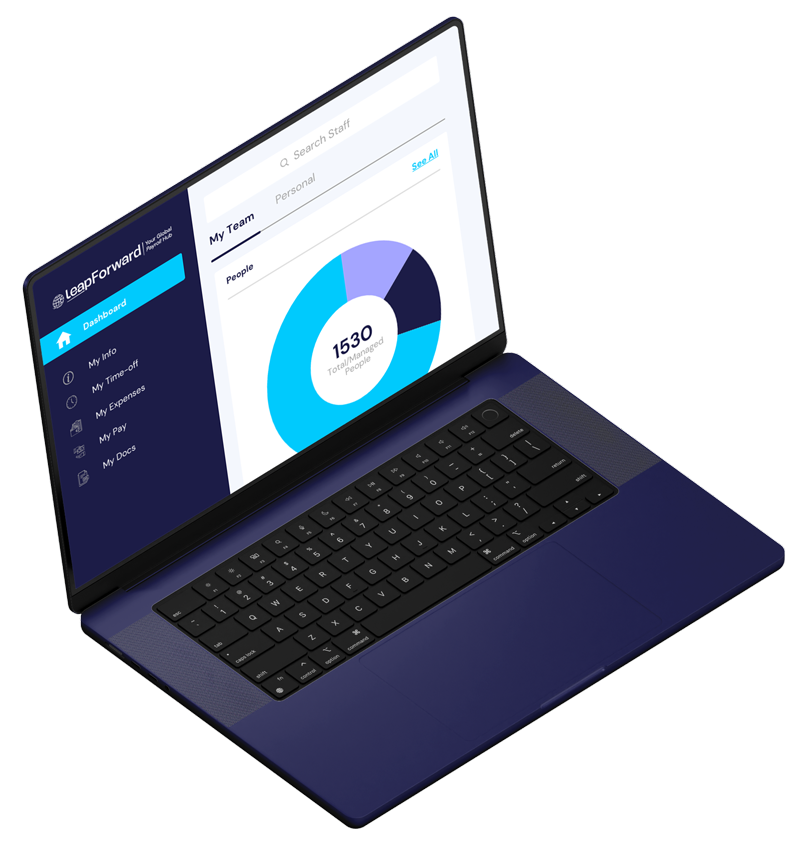
Not to mention, our powerful multi-country payroll software, LeapForward, gives you:
Full control over your global employment costs.
Instant access to real-time reporting, formatted in a way that’s easy to understand.
Prompt processing of any salary and payroll changes for an efficient turnaround.
Trusted global partner for…


Switching Global Payroll Providers: Frequently Asked Questions (FAQs)
How long does it take to switch global payroll providers?
The timeline for switching global payroll providers depends on the number of countries, data quality and the current provider’s cooperation, as well as each regulator and bank’s individual lead times.
- Small Businesses & Simple Setups: 10 days to 4 weeks.
- Medium Businesses & Multi-Country Setups: 1-3 months.
- Large Enterprises & Multi-Jurisdiction Setups: 3-6 months (or longer).
Can I switch global payroll providers mid-year?
Yes. Switching global payroll providers mid-year can be more complex, but is sometimes necessary if your current partner isn’t offering a satisfactory service.
Don’t wait for a clean calendar break in the year if your current payroll provider is:
- Repeatedly making payroll errors
- Missing filings
- Lacking country-specific compliance knowledge and expertise
Switching mid-year does require importing partial-year wage and tax data, but Leap29 can help make the transition easier by running a parallel pay cycle before you move over to us.
What data do I need from my current global payroll provider before switching to a new one?
At a minimum, you should provide all of the following information:
- Employee details and banking information
- Statutory and tax information per country (e.g. Tax IDs and codes, National Insurance/Social Security numbers, etc.)
- Year-to-date and historical pay figures (including deductions and taxes)
- Benefits, pensions and leave balances/records
- Employer and entity compliance data (e.g. Employer registrations and sign-off structures)
How much do Leap29’s global payroll services cost and what’s included?
Leap29’s global payroll services start at $15 per employee, per month. Here’s what’s included:
- 99.99% payroll accuracy.
- Optional API integrations with your HR, finance and accounting packages.
- Local, regional and HQ-level support from payroll experts.
- Visual presentations of your data to help drive more informed business decisions.
- Optional additional services including tax and labour authority handling, compliance management/monitoring and extra HR support.
Get a free, no-obligation global payroll quote today
Tell us where your employees are based and what isn’t working with your current provider, and we’ll show you what a smooth switch looks like.
Speak to a global payroll expert to get your free, no-obligation quote today.
"*" indicates required fields
Why use a global payroll provider?
Our global payroll services allow you to focus on the core, day-to-day operations of your business, while we handle the rest.
Ensuring you comply with all local requirements and keep your employees happy, we support you with:
- Maintaining employee retention by paying your staff in an accurate and timely manner every single pay period.
- Making the right social security, pension, benefit and bonus contributions/payments.
- Presenting your payroll data clearly and consistently across all of your different entities (if applicable).
Simple, transparent pricing.
From $15
Per employee per month
- No hidden fees
- 99.99% accuracy
- 180+ countries